A note on the figures. Our own daily notes are only just starting. Every 9:00 a.m. Tokyo time snapshot in this note — Saturday 7 through Saturday 14 November 2026, and the prior week from Saturday 31 October through Saturday 7 November — was reconstructed on the afternoon of Saturday 14 November 2026 from CoinGecko’s public hourly prices. They were not taken live at 9:00 a.m. Tokyo time on those mornings. Much of the earlier timeline was put together from public reporting on 13 and 14 November.
The week in this note runs from Saturday 7 November 2026, 9:00 a.m. Tokyo time, through Saturday 14 November 2026, 9:00 a.m. Tokyo time.
How the week compared
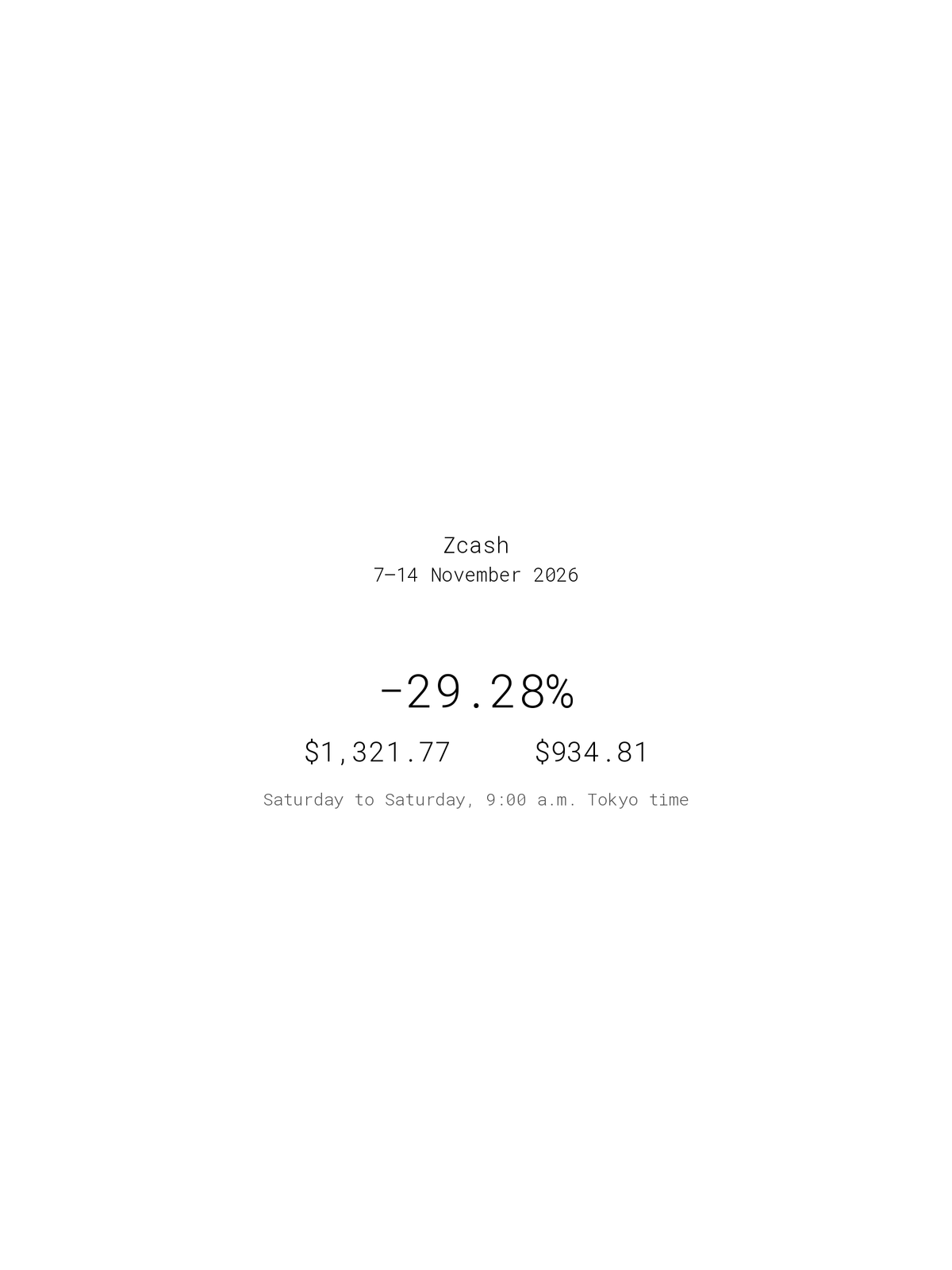
At 9:00 a.m. Tokyo time on Saturday 7 November, Zcash (ZEC) was $1,321.77 on CoinGecko. At the same clock time on Saturday 14 November, it was $934.81. That is a fall of $386.96, or 29.28%.
The 24-hour trading volume — CoinGecko’s running total of how much Zcash was traded, in U.S. dollars, over the past 24 hours, not a Saturday-to-Saturday total — was $1.24 billion at the start of the week and $1.05 billion at the end. The market cap, a rough measure of all Zcash added up at the going price, went from $22.51 billion to $15.93 billion.
On the same snapshots, bitcoin fell 9.85%, from $75,775.28 to $68,313.71. Ether fell 13.59%, from $2,236.28 to $1,932.28. Monero fell 13.35%, from $611.09 to $529.53. Zcash fell further than those three. That is a comparison, not a cause. USDT, a stablecoin (a cryptocurrency designed to stay close to a fixed value, usually one U.S. dollar), stayed very near $1 and is not treated as a driver this week.
The steepest morning-to-morning drop was Wednesday 11 November, when the 9:00 a.m. snapshot was 10.17% below Tuesday’s. Thursday was the first snapshot in this series below $1,000. From Friday morning to Saturday morning the price slipped another 2.18%.
Inside the week, CoinGecko’s hourly series — these are not the official 9:00 a.m. snapshots, and not a claim about the lowest trade on every exchange — printed a high of $1,350.07 at 11:00 a.m. on 7 November and a low of $892.49 at 2:00 p.m. on 13 November.
Compared with the prior week
The natural comparison is the previous Saturday-to-Saturday window: 9:00 a.m. Tokyo time on Saturday 31 October 2026 through the same time on Saturday 7 November. Those earlier 9:00 a.m. figures were also reconstructed this afternoon from CoinGecko’s public hourly history. They were not written down at 9:00 a.m. on those days.
In that prior week, Zcash rose from $1,269.13 to $1,321.77, a gain of $52.64, or 4.15%. On the same snapshots, bitcoin slipped 1.94%, from $77,275.05 to $75,775.28; ether slipped 0.28%, from $2,242.50 to $2,236.28; and monero rose 4.06%, from $587.26 to $611.09. USDT again stayed very near $1.
This week reversed that rise, and then some. Zcash fell 29.28%, while bitcoin, ether, and monero also turned lower (by about 10%, 14%, and 13%). The prior week’s lowest 9:00 a.m. snapshot was $1,133.54 on Tuesday 3 November. The price then rose into the end of that week, closing at $1,321.77. At 9:00 a.m. on Friday 6 November the snapshot was $1,279.69, two hours and 34 minutes before NU7 went live.
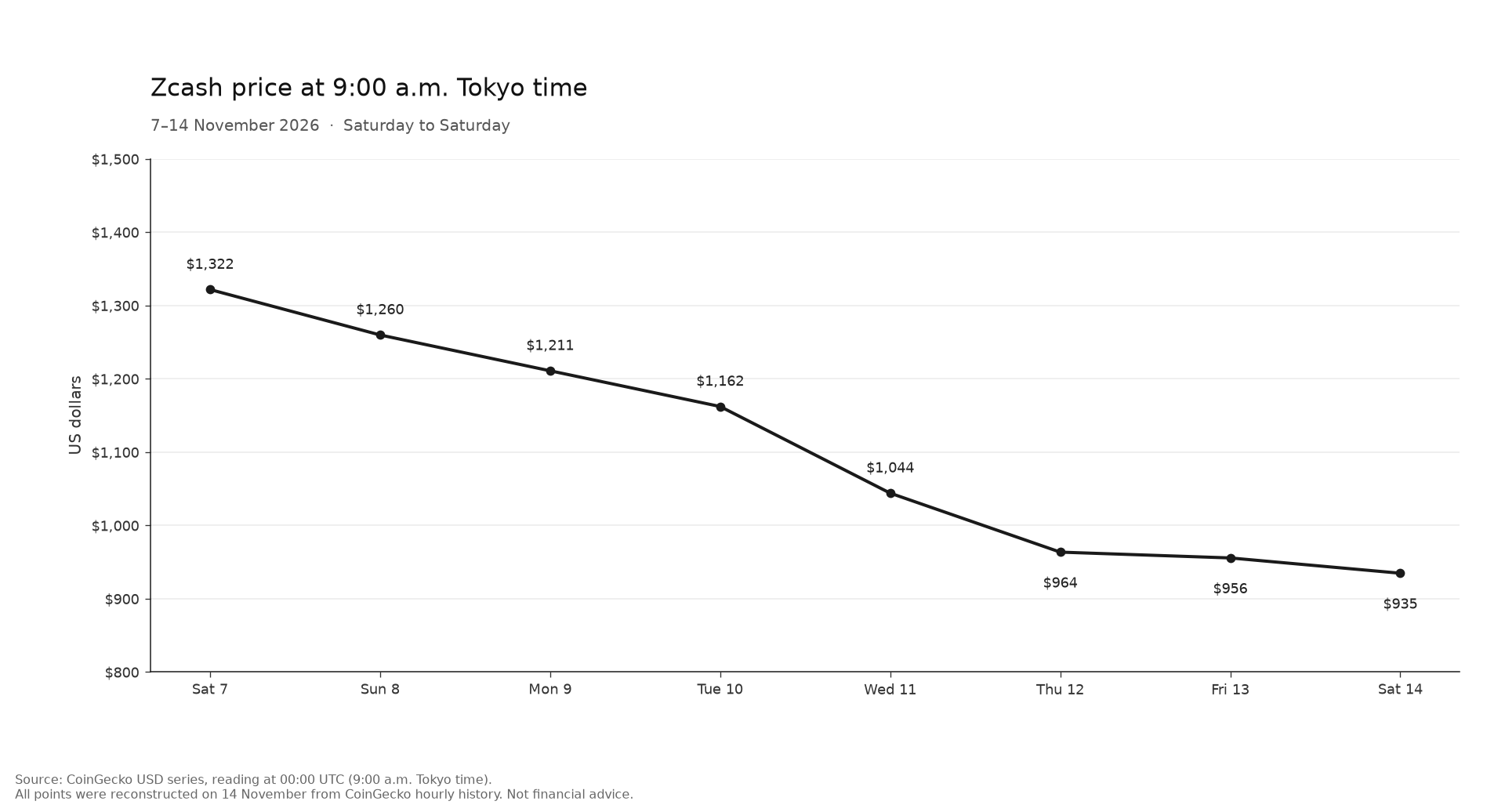
Source: CoinGecko hourly USD series, reading at 00:00 UTC (9:00 a.m. Tokyo time). All points were reconstructed on 14 November 2026 from CoinGecko hourly history.
Timeline
Times are Tokyo time unless noted.
- Friday 6 November, 11:34 a.m. (02:34 UTC) — just before this week began. Zcash’s NU7 network upgrade went live at block 3,543,405. A network upgrade is a planned change to the rules that computers on the network follow together. Official word came from the @Zcash account and from ZIP 259, the deployment document. In short: the target time between blocks went from 75 seconds to 25 seconds; 60% of transaction fees now go into a reserve to help pay miners later; and some older transaction types, including leftover funds in Sprout, the original private pool, can no longer be spent. A shielded pool, or private pool, is a part of Zcash where coins can be held with stronger privacy, so the usual public record does not show the amounts and parties in the ordinary way. CoinDesk, 6 November, reported the activation and, citing other trackers, said a few hours of early block times were still settling and that about 12,224 ZEC left in Sprout became unspendable, with no recovery plan approved as of that Friday. The Foundation’s node software release is Zebra 7.0.0. Caution: z.cash/upgrade/nu7 was still out of date when last checked on 13 November. Prefer ZIP 259 and the official posts.
- Saturday 7 November, 9:00 a.m. Zcash was $1,321.77, with 24-hour volume of $1.24 billion. That is the opening snapshot for this week.
- Sunday 8 November, 9:00 a.m. The price was already down 4.69%, at $1,259.82. A deadline later that UTC day — 8:59 a.m. Tokyo on Monday 9 November — for proposal submissions ahead of the coming polls, and a later draft to cut block time again from 25 seconds to 20, sat in the background. The 20-second idea was posted on the Zcash Community Forum at 5:56 a.m. Tokyo on Monday 9 November (20:56 UTC on 8 November). It has not been approved and has no start date.
- Monday 9 November, 9:00 a.m. The price was $1,210.95, down 3.88% from Sunday. CoinDesk, 9 November, reported the 20-second idea and early figures on discarded blocks, with a warning that the tracking coverage had changed, so before-and-after numbers are not a clean match.
- Tuesday 10 November, 9:00 a.m. Zcash was $1,162.22, already down 4.02% from Monday, before the main U.S. morning announcement later that Tokyo day.
- Tuesday 10 November, 10:00 p.m. (8:00 a.m. Eastern Time). Grayscale launched Zcash Invest, an educational site and campaign around Zcash and The Zcash ETF (ticker ZCSH). An ETF, or exchange-traded fund, is a fund that holds ZEC and trades on a stock exchange, so people can get price exposure without holding the coin themselves. Grayscale said it plans to direct $1 million to ecosystem groups and had already awarded the first $400,000 as $100,000 grants to the Zcash Foundation, Pretty Good Policy for Zcash, Shielded Labs, and Project Tachyon. It also said it intends to use 100% of ZCSH sponsor fees, for up to the fund’s first year, on development, marketing, and education — a voluntary commitment the sponsor can change or end. A national campaign was to begin that day with a Wall Street Journal wrap. The Foundation, Shielded Labs, and Project Tachyon later thanked Grayscale; @Zcash reposted those notes.
- Wednesday 11 November, 9:00 a.m. The steepest snapshot drop of the week: $1,044.03, down 10.17%, with 24-hour volume of $1.22 billion. This print is before a specification draft was merged later that day, and before the U.S. trading session on Wednesday 11 November. (9:00 a.m. Tokyo time is 7:00 p.m. Eastern Time on Tuesday 10 November.)
- Wednesday 11 November, 12:34 p.m. (03:34 UTC). A draft Zcash Improvement Proposal — a formal write-up of a possible rule change — was merged as zcash/zips#1428. The public text is draft-mcgee-future-dev-legal-defense-fund, by Sean Bowe, Zooko Wilcox, and Jason McGee. If later approved and activated, it would move 50,000 ZEC out of the grants treasury into the sustainability reserve within 30 days, and redirect the grants committee’s 8% of new coins into a locked fund for future development and legal defense that nobody can spend from until a later proposal says how. This is not in force. Other drafts are also in front of the community. CoinDesk, 12 November, recapped the ZIP and the 16–30 November polls. This note uses “50,000 ZEC,” not a fixed dollar total, because the dollar value moves with the price.
- Thursday 12 November, 9:00 a.m. The first snapshot below $1,000, at $963.59.
- Friday 13 November, 9:00 a.m. $955.66, a smaller additional decline. Official protocol news was quieter. Later on Friday, CoinGecko’s hourly series printed $892.49 at 2:00 p.m., the lowest hourly point in this week’s window, before the price moved back into the mid-$900s.
- Friday 13 November, later in the day. After this week’s Friday 9:00 a.m. snapshot, bitcoin fell below $70,000. CoinGecko’s first hourly bitcoin print below $70,000 in this series was $68,890.88 at 1:00 p.m. Tokyo time (04:00 UTC). CoinDesk, 13 November described a 12-week low, a stronger U.S. dollar, and traders pricing in a possible Federal Reserve interest-rate increase at the 8–9 December meeting. Later that day, at 8:30 a.m. Eastern Time (10:30 p.m. Tokyo time), the U.S. Bureau of Labor Statistics said the Producer Price Index for final demand rose 0.3% in October and 6.5% over the 12 months ended in October. From Friday morning to Saturday morning, Zcash’s 9:00 a.m. snapshot fell 2.18%, less than bitcoin, ether, and monero on the same snapshots. That is a comparison, not a claim that the inflation report or the bitcoin move caused Zcash’s change.
- Saturday 14 November, 9:00 a.m. $934.81, down another 2.18% from Friday morning, with 24-hour volume of $1.05 billion. No new official project release dated this Saturday morning was found in this pass.
A third-party table of fund flows is also part of the week’s context, not a proven cause. Farside Investors, checked on 14 November, shows net outflows from ZCSH on most U.S. sessions from 9 to 13 November, totaling $30.8 million on that table, including $14.6 million on 11 November and $4.1 million on 13 November. Farside compiles these figures; they are not a statement from Grayscale, and this pass did not check the fund’s own filings. As noted above, Wednesday morning’s 9:00 a.m. Tokyo snapshot was already lower before that Wednesday U.S. session (that 9:00 a.m. Tokyo clock time is 7:00 p.m. Eastern Time on Tuesday 10 November).
Five things that stood out
These are the points that seem most useful for readers, and that may have sat alongside the price move. We do not claim that any one of them caused the week’s decline.
- The week’s price drop. Zcash went from $1,321.77 to $934.81 on the Saturday 9:00 a.m. snapshots, down 29.28%, more than bitcoin, ether, or monero on the same source. The sharpest morning in the series was Wednesday. Thursday was the first snapshot below $1,000. We do not know what caused the move.
- NU7 going live on 6 November, just before the week began: faster target block times, the new fee reserve, and the official confirmation from @Zcash and ZIP 259. This is the main change in how the network itself works sitting behind the week.
- Grayscale’s 10 November commitment and campaign, including first grants to official and core ecosystem groups, with the important caveat that the fee reinvestment is voluntary and can end. In the same week, Farside’s table shows further outflows from the Zcash ETF. Those are two sides of the same institutional story, not proof that either one moved the price.
- The 50,000 ZEC grants-treasury draft, merged on 11 November, with polls scheduled for 16–30 November. This is a vote on a proposal, not a change already in the software. Other proposals are also in front of voters.
- A weaker week for the wider crypto market, used only as context. Bitcoin, ether, and monero all fell on the same snapshots, though Zcash fell further. That comparison is not a trading signal and does not explain the size of Zcash’s move.
What to watch
This is a short look at what is already on the calendar, not a forecast of the price, not a target, and not a suggestion to buy or sell Zcash or any other asset. This note is not financial advice.
The main date range to watch is 16–30 November, when coinholder and community-panel polls on the grants and lockbox draft — and possibly other proposals — are scheduled, closing at 11:59 p.m. UTC on the 30th (8:59 a.m. Tokyo time on 1 December). Those polls are a process, not a result, and they have not begun as of Saturday 14 November.
The idea of cutting the target time between blocks again, from 25 seconds to 20, is still only a proposal. A later upgrade, sometimes discussed as NU7.1, still has no date.
The Federal Reserve’s next scheduled policy meeting is 8–9 December 2026. That is a wider-market date already on the calendar, not a Zcash event, and it is not a forecast of the coin’s price.
Readers may also want to watch whether the market is calmer after a large down week, and whether official project channels say more about the polls. That is something to observe, not a prediction.
Sources
- CoinGecko API v3, ZEC-USD and context-coin market charts, exact 00:00 UTC (9:00 a.m. Tokyo time) points, all retrieved on 14 November 2026 in the afternoon, Tokyo time, not taken live at 9:00 a.m. Tokyo on those mornings. The same method and the same afternoon pull were used for the prior week (31 October through 7 November).
- ZIP 259: Deployment of the NU7 Network Upgrade
- Official @Zcash post on NU7 activation
- Zebra 7.0.0, Zcash Foundation
- CoinDesk, “Zcash’s landmark NU7 upgrade goes live, speeding up private payments”, 6 November 2026
- Zcash Community Forum, “Proposal: Lower Zcash block target spacing from 25s to 20s”, 8 November 2026
- CoinDesk, “Zcash developers want 20-second blocks just days after major speed upgrade”, 9 November 2026
- Grayscale Investments, “Grayscale Launches Zcash Invest and Commits $1 Million to Support the Zcash Ecosystem”, 10 November 2026
- Draft ZIP: Future Dev and Legal Defense Fund Lockbox…
- CoinDesk, “Zcash holders to vote on pulling 50,000 ZEC… from grants treasury”, 12 November 2026
- Farside Investors, Zcash ETF Flow, checked 14 November 2026 (page dated 14 November 2026)
- CoinDesk, “Bitcoin hits 12-week low as dollar rallies on interest-rate outlook…”, 13 November 2026
- U.S. Bureau of Labor Statistics, Producer Price Index — October 2026, released 13 November 2026